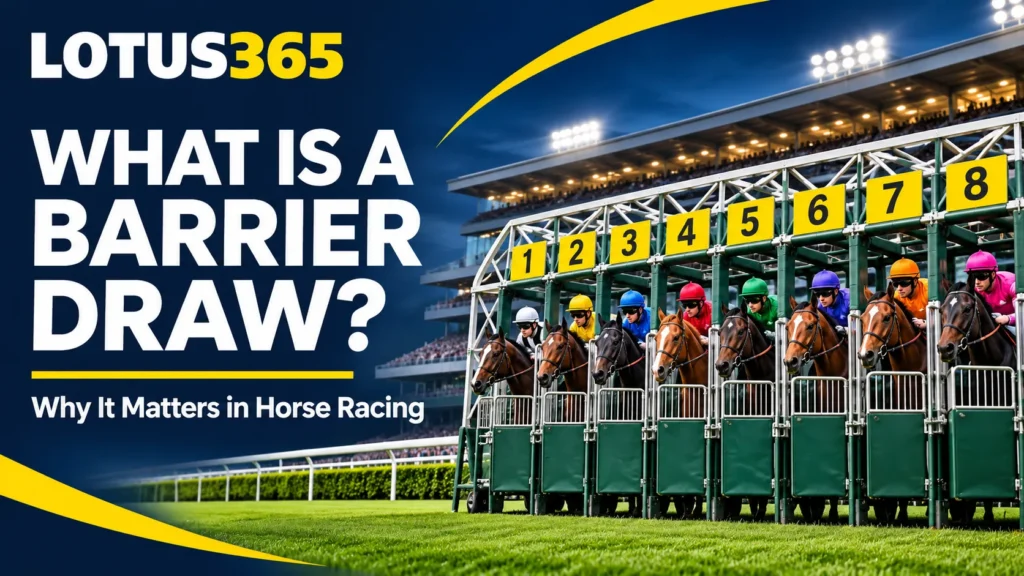
A barrier draw assigns each horse its starting gate or stall in a race. For Indian readers following lotus 365 sports explainers, it helps explain why two runners may face different challenges before they reach the first turn.
The starting position can influence the ground covered, early positioning, and access to a clear run. However, a favourable draw does not guarantee victory, and an outside gate does not automatically rule a horse out.
This guide focuses on thoroughbred races that start from stalls.
How Does a Barrier Draw Work?
Each runner receives an allocated stall before the race. The allocation procedure depends on the racing authority and competition.
Racing New South Wales explains that an approved computer system randomly allocates stall numbers. Some prominent races use a supervised public draw involving owners.
In systems such as Hong Kong racing and the Melbourne Cup, lower barrier numbers are nearer the inside running rail. Always check the local racecard and course layout rather than assuming numbering works identically everywhere.
Is the Barrier Number the Same as the Horse Number?
No. The horse number identifies the runner; the barrier number identifies its starting position.
For example:
| Racecard detail | Meaning |
|---|---|
| Horse number 7 | The runner’s identification number |
| Barrier 2 | Its allocated starting stall |
| Jockey | The rider |
| Weight | The assigned weight carried |
| Distance | The length of the race |
Horse number 7 can start from barrier 2. Hong Kong Jockey Club’s beginner material explicitly distinguishes horse numbers from draw numbers.
Confusing these columns can lead to an incorrect interpretation of the race.
Why Does the Barrier Draw Matter?
1. It Can Affect the Distance Covered
On a turning course, a horse travelling around the outside may cover more ground than a runner nearer the rail.
An inside starting position can help a horse obtain a shorter route. However, the actual route depends on its start, surrounding runners, and the jockey’s decisions.
2. It Influences Early Positioning
A horse drawn wide may need to move forward, remain outside, or settle behind other runners.
An inside-drawn horse may obtain a useful position but could also find itself behind horses with limited room to move.
These are possible race scenarios, rather than fixed outcomes.
3. It Interacts With Running Style
A horse that usually races prominently faces a different positioning question from one that settles near the back.
The Victoria Racing Club illustrates this through Kiwi’s 1983 Melbourne Cup: despite starting from an inside barrier, the horse settled at the rear before making its winning run wider in the straight.
The example shows why a barrier number should be read alongside the horse’s usual racing pattern.
Is an Inside Draw Always Better?
No. The importance of an inside position depends on the race.
| Factor | Why it changes the assessment |
|---|---|
| Distance to the first turn | A short approach may create more immediate positioning pressure |
| Field size | More runners can mean more competition for space |
| Straight or turning course | The shortest-route question differs |
| Early speed | Determines which horses can establish position |
| Surface and rail placement | Influence the available racing lanes |
| Running style | Affects how the jockey may use the starting position |
Readers searching lotus365 online id racing information should therefore ask “Does this draw suit this horse in this race?” rather than searching for one universally favourable gate.
What Is Draw Bias?
Draw bias describes a recurring advantage or disadvantage associated with starting positions under particular conditions.
Reliable analysis needs comparable races. Hong Kong Jockey Club’s draw statistics organise results by surface, course configuration, and distance, showing runners, winners, and place-getters for each draw.
A stall producing several winners does not establish that it will produce the next winner. Consider:
- How many runners started from that position.
- Whether field sizes were comparable.
- Whether course conditions changed.
- Whether the sample is large enough to support a conclusion.
Can Withdrawals Change the Starting Position?
Yes, depending on the jurisdiction’s procedures.
The Victoria Racing Club explains that, in the Melbourne Cup, withdrawals can move outside runners inward. Its example shows Shocking drawing barrier 23 in 2009 but starting from 22 after an inside runner was withdrawn.
This means the original draw and actual starting position may differ. Check the final official field rather than relying only on an early announcement.
Read More : Lotus365 Cricket Online ID Password Recovery Guide
How to Read a Barrier Draw Step by Step
Use this checklist when following lotus 365 racing coverage:
- Identify the race: Confirm the course, distance, and start time.
- Separate horse and barrier numbers: Read the correct racecard columns.
- Check the final field: Look for withdrawals and revised positions.
- Inspect the course: Establish where the first turn occurs.
- Consider running style: Think about likely early positioning.
- Use comparable statistics: Avoid combining unrelated distances and surfaces.
This process turns a gate number into useful race context without treating it as a prediction.
Conclusion
A barrier draw determines where a horse starts, while the race determines how effectively it uses that position. For lotus365 online id readers, the clearest approach is to combine the draw with course layout, field size, running style, and the final declarations.
FAQs
Does barrier 1 guarantee the shortest race?
No. It may provide access to an inside route, but the horse’s actual position can change.
Can a horse win from a wide barrier?
Yes. Starting position is only one influence on a race.
Are barrier draws always random?
Procedures vary. Racing NSW describes computer allocation and supervised public draws.
What is the difference between a barrier draw and a barrier trial?
A draw allocates starting positions. A trial is a practice or assessment event; its requirements depend on the racing authority.
Where should beginners check the draw?
Use the organising racing club’s or authority’s official racecard and final declarations.